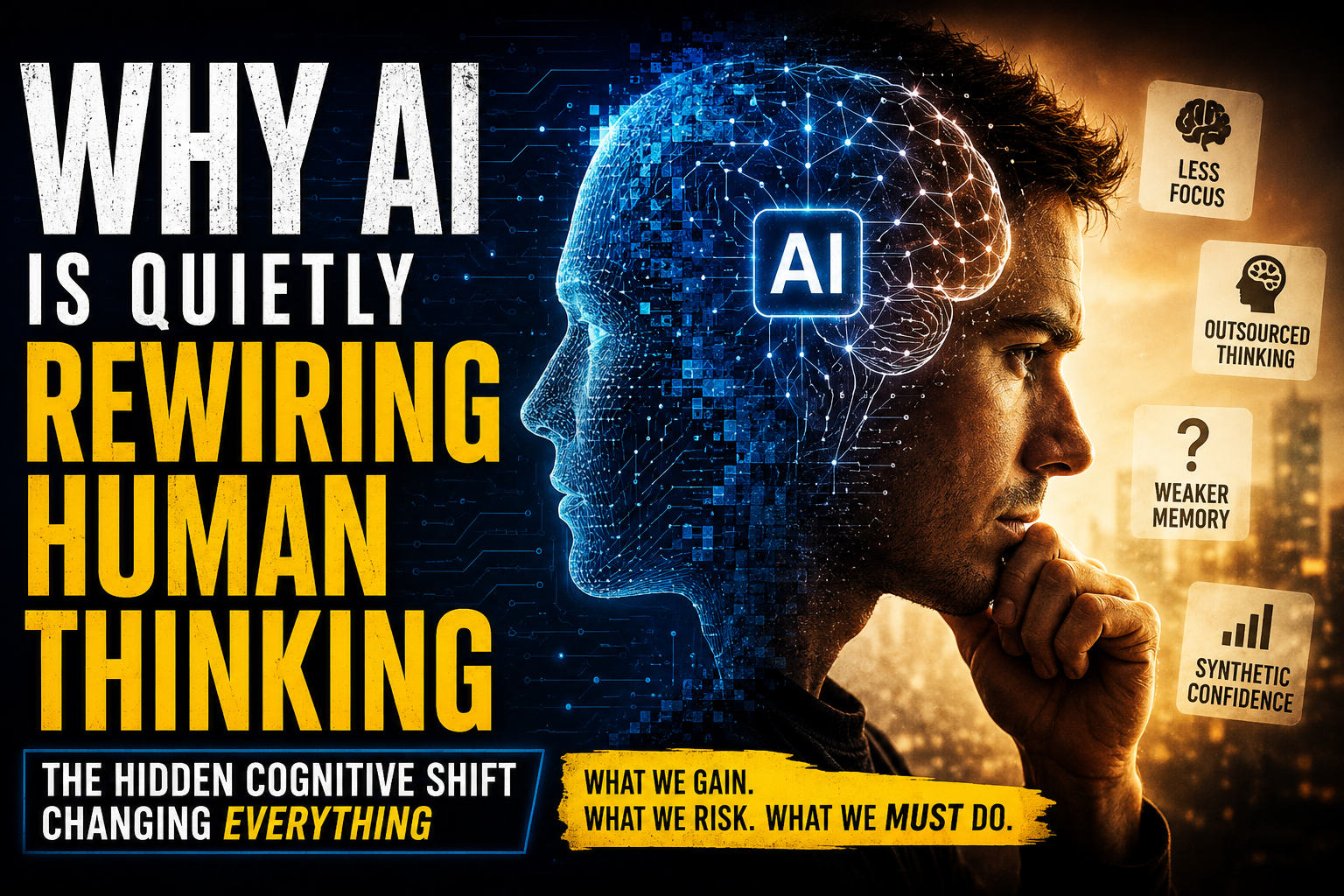

The invisible cognitive shift happening beneath our habits, decisions, memory, and attention
Introduction
Something strange has happened over the past few years.
People increasingly feel both more capable and more mentally exhausted.
We can write faster, search faster, summarize faster, decide faster. Answers arrive instantly. Blank pages disappear. Friction dissolves. Entire forms of expertise feel compressible into prompts.
And yet many people report a growing sense of cognitive unease.
They forget things they used to remember. Reading feels harder. Sustained concentration feels fragile. Decision-making feels oddly outsourced. Creativity sometimes feels accelerated—and strangely hollow at the same time.
This contradiction is worth paying attention to.
Because the real story of artificial intelligence is not merely that machines are becoming more intelligent.
It is that humans are beginning to think differently.
Quietly.
Incrementally.
Often invisibly.
Every major technology changes human behavior. Writing changed memory. Clocks changed our relationship with time. Search engines changed information retrieval. Smartphones fragmented attention.
But AI may represent something deeper.
Unlike previous tools, AI does not simply store knowledge or deliver information. It increasingly participates in cognition itself.
It drafts ideas. Synthesizes information. Makes suggestions. Anticipates needs. Generates alternatives. Predicts preferences. Simulates reasoning.
The boundary between thinking for yourself and thinking with a system is becoming harder to distinguish.
And the important question is no longer whether AI will change human thinking.
It already is.
The more important question is this:
What kind of thinkers are we becoming?
The Real Shift: From Information Scarcity to Cognitive Abundance
For most of human history, intelligence meant dealing with scarcity.
Scarcity of information.
Scarcity of expertise.
Scarcity of access.
If you wanted answers, you searched libraries. Consulted experts. Studied for years. Accumulated knowledge slowly.
Intelligence was often defined by recall.
The smartest person in the room was frequently the one who knew the most.
The internet disrupted this model.
Search engines externalized memory.
You no longer needed to remember everything. You needed to know where to find it.
AI is disrupting the model again.
Now we are externalizing not just memory—but increasingly parts of reasoning itself.
This is a subtle but profound difference.
Search engines answered:
“Where can I find information?”
AI increasingly answers:
“Let me think through this for you.”
That sentence changes cognition.
Because humans adapt to tools.
Always.
Psychologists sometimes call this cognitive offloading: transferring mental effort to external systems.
We already do this constantly.
- Calendars remember appointments.
- GPS remembers geography.
- Smartphones remember phone numbers.
- Search engines remember facts.
AI expands this dramatically.
Now systems can remember structure, generate ideas, compare options, summarize complexity, critique writing, prioritize tasks, and even simulate debate.
The benefit is obvious.
The risk is quieter.
If we outsource too much cognition, we may unknowingly weaken the mental muscles required to think independently.
Not because people become less intelligent.
But because intelligence changes shape.
The New Cognitive Trade-Off
Every technological gain hides a psychological trade-off.
Cars increased mobility but reduced everyday physical movement.
Streaming expanded entertainment but weakened intentional viewing.
Social media expanded connection but altered attention.
AI introduces a new trade-off:
Cognitive efficiency versus cognitive depth.
This is not a moral panic.
Efficiency matters.
Nobody wants to manually summarize a 300-page report if software can do it in seconds.
Nobody wants unnecessary friction.
But friction sometimes serves a hidden function.
Thinking itself often emerges from effort.
A student who struggles through an argument may understand it more deeply than someone receiving an instant explanation.
A writer wrestling with sentences may discover better ideas than someone accepting first-pass AI outputs.
A strategist manually comparing options may develop stronger judgment than someone instantly receiving recommendations.
In psychology, this resembles something called desirable difficulty.
Certain forms of struggle improve learning.
Effort creates understanding.
Convenience removes effort.
And AI introduces convenience at unprecedented scale.
This creates a paradox:
The easier thinking becomes, the easier it becomes to stop truly thinking.
The Quiet Rise of Cognitive Passivity
One of the most underestimated risks of AI is not misinformation.
It is passivity.
Human cognition is deeply shaped by defaults.
People naturally conserve mental energy.
This is not laziness.
It is efficiency.
The brain constantly minimizes cognitive load.
If a system offers a plausible answer instantly, most people experience an unconscious temptation:
“That seems good enough.”
This changes behavior.
Instead of generating ideas, people curate suggestions.
Instead of reasoning deeply, people validate outputs.
Instead of exploring possibilities, people choose among generated options.
The role shifts from creator to selector.
This sounds harmless.
Sometimes it is beneficial.
But over time, repeated cognitive passivity changes mental habits.
Think about recommendation systems.
People once actively searched for music.
Now playlists decide.
People once browsed intentionally.
Now feeds anticipate desire.
Choice increasingly becomes prediction.
AI pushes this further into intellectual life.
Imagine these scenarios:
Example: Creative Work
A designer opens AI before brainstorming.
Instead of exploring original directions, they begin by reacting to generated concepts.
The first idea no longer comes from imagination.
It comes from the machine.
This subtly changes creative ownership.
The starting point matters.
Psychologists call this anchoring.
First inputs heavily shape later thinking.
Generated suggestions become invisible anchors.
Example: Writing
A writer faces an empty page.
Historically, the struggle of forming ideas produced insight.
Now AI drafts instantly.
The writer edits.
Productivity rises.
But there is a hidden question:
Did the writer accelerate thought—
or bypass the difficult process where original thinking emerges?
These are not identical outcomes.
Example: Decision-Making
Managers increasingly ask AI:
- Which strategy seems strongest?
- What are the risks?
- How should we prioritize?
Reasonable questions.
But judgment develops through repeated evaluation.
If AI performs too much synthesis, decision-makers may unknowingly weaken strategic intuition.
Like muscles that weaken through disuse.
Why Attention Feels More Fragile Than Ever
To understand AI’s effect on thinking, we must understand attention.
Attention is not merely focus.
It is cognitive currency.
What receives attention shapes thought.
What interrupts attention fragments thought.
Modern technology already weakened attentional stability.
Notifications.
Infinite feeds.
Context switching.
Algorithmic stimulation.
AI may intensify this in an unexpected way.
Not because it distracts.
But because it accelerates.
Thinking used to unfold slowly.
Questions lingered.
Ideas matured.
Uncertainty remained unresolved for longer.
Now ambiguity collapses instantly.
You wonder something.
AI answers.
You hesitate.
AI suggests.
You struggle.
AI drafts.
Micro-friction disappears.
This feels empowering.
But reflection often lives inside delay.
Many important insights arrive during unresolved thinking.
The unanswered period matters.
When everything becomes instantly answerable, reflection may shrink.
The result?
A growing intolerance for mental uncertainty.
People increasingly feel uncomfortable not knowing.
We become cognitively impatient.
This matters more than it seems.
Because wisdom often requires sitting with complexity longer than comfort prefers.
The Memory Problem Nobody Talks About
People often say:
“Why remember anything when AI remembers for us?”
Reasonable question.
But memory is not merely storage.
Memory shapes identity.
Reasoning.
Creativity.
Judgment.
Knowledge networks inside the brain enable pattern recognition.
Experts think differently because information becomes deeply interconnected.
A doctor sees symptoms differently than a novice because years of stored knowledge create mental models.
If too much recall becomes externalized, we risk weakening internal knowledge structures.
This does not mean memorizing everything.
It means preserving mental architecture.
Knowing enough deeply enough to reason independently.
AI works best when paired with internal understanding.
Without it, people become vulnerable to confident nonsense.
And AI is remarkably capable of producing persuasive nonsense.
The future may divide into two groups:
- People who use AI to amplify strong thinking.
- People who use AI to replace thinking.
The difference will become economically significant.
The Hidden Psychological Risk: Synthetic Confidence
One overlooked effect of AI is how it changes certainty.
Humans often confuse fluency with truth.
If something sounds polished, people trust it more.
AI speaks confidently.
Smoothly.
Authoritatively.
Even when wrong.
This creates a dangerous cognitive shortcut.
Instead of evaluating ideas critically, users may defer to persuasive outputs.
Especially under time pressure.
This risk grows in areas like:
- finance
- medicine
- hiring
- law
- education
- strategic planning
The problem is not intelligence.
The problem is overtrust.
AI can produce answers that feel complete while quietly omitting uncertainty.
The human brain loves closure.
We prefer certainty to ambiguity.
AI satisfies that preference.
Sometimes falsely.
Which means one of the most valuable future skills may become:
epistemic humility—the ability to ask:
“How sure should I actually be?”
Recommendation Systems Were the Prototype
To understand where this is heading, look backward.
Social media algorithms already rewired attention.
Streaming platforms rewired discovery.
E-commerce rewired purchasing behavior.
Maps rewired spatial memory.
Notifications rewired urgency.
AI is not appearing in isolation.
It is arriving after twenty years of behavioral optimization.
Technology already learned how to shape habits.
Now it is learning how to shape thought.
This is historically significant.
Because recommendation systems optimized:
what people consume.
AI systems increasingly influence:
how people reason.
That is a much deeper layer of human behavior.
The Future Skill Nobody Is Talking About: Cognitive Sovereignty
A useful phrase for the next decade may be:
cognitive sovereignty.
The ability to think independently in environments optimized to think for you.
This does not mean rejecting AI.
It means relating to it consciously.
The healthiest future is not anti-AI.
Nor is it total dependence.
It is partnership.
AI as augmentation.
Not substitution.
The key question becomes:
“Am I using this system to sharpen my thinking—or avoid it?”
That distinction matters.
Because outsourcing effort can quietly become outsourcing agency.
A Practical Framework: The Three Layers of AI Thinking
A useful mental model:
Layer 1: Acceleration
Use AI for speed.
Examples:
- summarizing documents
- organizing notes
- formatting ideas
- generating drafts
Low cognitive risk.
High leverage.
Layer 2: Exploration
Use AI to expand perspective.
Examples:
- alternative viewpoints
- debate simulations
- idea generation
- scenario testing
Higher value.
Still healthy.
You remain intellectually engaged.
Layer 3: Substitution
Danger zone.
This is where people stop reasoning independently.
Examples:
- unquestioned recommendations
- outsourced judgment
- passive acceptance
- automatic conclusions
This is where cognitive decline can quietly begin.
The practical rule:
Accelerate mechanics. Preserve judgment.
Practical Strategies to Protect Your Thinking
1. Delay AI Slightly
Before asking AI, think first.
Even for five minutes.
Write rough ideas.
Generate hypotheses.
Then compare with AI.
This preserves originality.
2. Practice “Friction Thinking”
Choose occasional hard thinking.
Read long-form content.
Solve problems manually.
Write without assistance sometimes.
Cognitive effort remains essential training.
3. Use AI as Opposition
Instead of asking:
“What is the answer?”
Ask:
“What am I missing?”
Or:
“Argue against my conclusion.”
This strengthens reasoning.
4. Separate Drafting from Judgment
Let AI generate possibilities.
But reserve final decisions for yourself.
Especially in important areas.
5. Build Internal Knowledge
Do not outsource fundamentals.
Learn deeply.
Mental models compound.
Without foundations, AI becomes intellectually dangerous.
Reflective Exercise: A Small Cognitive Audit
Ask yourself:
- What tasks do I no longer think through myself?
- Am I becoming faster—or more dependent?
- When was the last time I struggled through a hard problem without assistance?
- Has convenience improved my thinking—or weakened patience?
These questions matter.
Because cognitive shifts happen gradually.
Rarely dramatically.
Key Insights
- AI changes not only productivity but cognition.
- Cognitive offloading is useful but carries hidden trade-offs.
- Efficiency can weaken depth if overused.
- Attention suffers when uncertainty disappears too quickly.
- Memory matters because it shapes reasoning.
- The biggest risk may be cognitive passivity, not intelligence loss.
- The future advantage belongs to people who collaborate with AI without surrendering judgment.
Conclusion
The biggest misunderstanding about artificial intelligence is believing its primary story is technological.
It is psychological.
AI is quietly redesigning the conditions under which human thinking happens.
The speed of answers changes patience.
The abundance of suggestions changes creativity.
The convenience of cognition changes judgment.
The danger is not that machines suddenly become smarter than humans.
The danger is subtler.
That humans gradually stop exercising the parts of thinking that once made intelligence resilient.
But decline is not inevitable.
Technology shapes behavior.
Behavior shapes cognition.
And cognition remains trainable.
The future likely belongs neither to pure human thinkers nor pure machine dependence.
It belongs to people who learn something harder:
how to think deeply while thinking alongside machines.
Because in an age where intelligence becomes abundant, independent judgment may become the rarest skill of all.
FAQ
Is AI making humans less intelligent?
Not necessarily. AI changes how intelligence is expressed. It can amplify capability but may weaken certain cognitive habits if used passively.
Does using AI reduce creativity?
It depends on how it is used. AI can expand idea generation but may also anchor thinking and reduce originality if people rely too heavily on first outputs.
What is cognitive offloading?
Cognitive offloading is transferring mental effort to external tools, such as calendars, GPS, search engines, or AI systems.
Should people avoid using AI for thinking?
No. The goal is conscious use. AI works best as an intellectual partner, not a replacement for reasoning.
What skill will matter most in the AI era?
Independent judgment—the ability to evaluate information critically, think clearly, and avoid overreliance on machine-generated certainty.