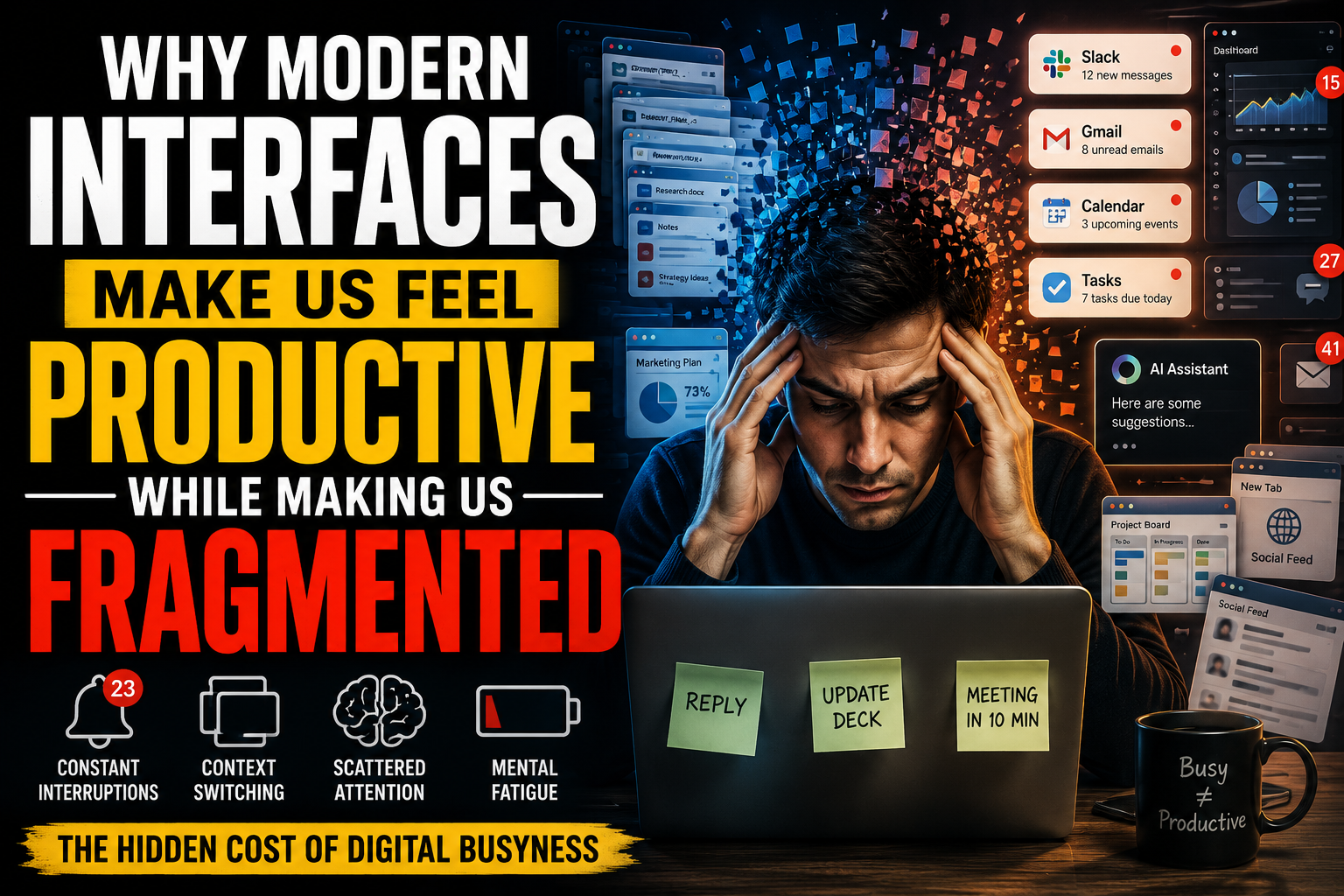

The hidden psychological cost of dashboards, notifications, AI assistants, and interfaces designed to keep us moving—but not necessarily thinking
Introduction
Modern work feels strangely exhausting.
Not physically exhausting.
Not even traditionally mentally exhausting.
A different kind of fatigue.
The kind where you end the day having done many things—answered messages, moved tasks, checked dashboards, organized notes, skimmed documents, responded to notifications—yet struggle to explain what meaningful progress was actually made.
You were busy.
Constantly busy.
But somehow cognitively scattered.
This experience has become so common that many people now mistake it for adulthood, modern work, or the unavoidable price of being digitally connected.
But something deeper is happening.
We are living inside interfaces that increasingly make us feel productive while quietly fragmenting our attention.
And the fragmentation is subtle because it rarely looks dysfunctional.
In fact, it often looks optimized.
Beautiful dashboards.
Smart notifications.
Organized workspaces.
Infinite integrations.
Frictionless communication.
Everything appears efficient.
Yet beneath the surface, many people experience:
- shorter attention spans
- difficulty sustaining deep focus
- chronic cognitive switching
- shallow decision-making
- mental fatigue without obvious accomplishment
- the uncomfortable feeling of always being “on”
This paradox deserves attention.
Because modern interfaces are not neutral.
They shape behavior.
They shape cognition.
And increasingly, they shape how we define productivity itself.
The uncomfortable possibility is this:
Modern interfaces may be optimizing us for visible activity while quietly undermining deep, meaningful work.
The Productivity Illusion
Look at a typical knowledge worker’s day.
Open laptop.
Check email.
Respond to Slack.
Review tasks.
Switch to browser.
Check analytics.
Open project board.
Attend meetings.
Reply to messages.
Update documents.
Reorganize notes.
Ask AI for summaries.
Repeat.
At almost every moment, something is happening.
Activity feels constant.
The brain interprets motion as progress.
But motion and progress are not the same thing.
Psychologists sometimes call this pseudo-productivity:
activity that creates the feeling of work without necessarily producing meaningful outcomes.
Modern interfaces are exceptionally good at generating this feeling.
Why?
Because they reward micro-actions.
Every click creates movement.
Every inbox reduction feels productive.
Every completed checkbox offers closure.
Every notification response feels responsible.
Every dashboard update feels informative.
You are doing things.
The problem is that many of these things exist in short, fragmented bursts of attention.
And fragmented attention changes cognition.
Why the Brain Loves Interface Activity
Human beings are highly responsive to visible progress.
This is ancient psychology.
We like signals of completion.
Progress bars.
Checkmarks.
Inbox zero.
Streak counters.
Visual confirmation reduces uncertainty.
This is partly why task-management systems feel satisfying.
Completing a task creates a small psychological reward.
A sense of order.
Control.
Achievement.
Technology companies understand this deeply.
Modern interfaces increasingly optimize for:
engagement through completion loops
Open notification → respond → reward.
Clear badge → relief.
Finish micro-task → satisfaction.
Move card → progress.
These loops are powerful because they generate momentum.
But there is a hidden cost.
The brain starts preferring easy completions over difficult thinking.
And difficult thinking is where meaningful work usually lives.
Writing a strategy document.
Solving a hard engineering problem.
Developing an original idea.
Reading deeply.
Making an important decision.
These activities often feel messy.
Unclear.
Slow.
They provide fewer immediate rewards.
Modern interfaces subtly train people toward the opposite:
short loops, fast feedback, visible movement.
This creates a dangerous behavioral shift.
We increasingly optimize for what feels productive rather than what actually matters.
The Interface Fragmentation Problem
Attention is not infinitely flexible.
The brain pays a cost every time it switches contexts.
And modern interfaces are designed around switching.
Open laptop.
Fifteen tabs.
Three messaging platforms.
Email.
Calendar.
Task manager.
Analytics dashboard.
AI assistant.
Documents.
Notifications arriving in real time.
Each tool seems individually useful.
Together, they create something cognitively expensive:
continuous partial attention.
You are technically focused.
But only partially.
Psychologist Linda Stone described this phenomenon years ago:
a state where attention remains divided because the brain anticipates incoming information.
This anticipation matters.
Even unread notifications affect cognition.
Why?
Because the brain maintains a low-level monitoring state.
A form of mental vigilance.
You may not consciously think about Slack.
But part of your attention remains reserved for Slack.
This creates what researchers often call attention residue.
Part of the mind stays behind in the previous task.
You switch to writing.
Part of you remains in email.
You return to strategy work.
Part of you remains in the meeting.
You start reading.
Part of you remembers unfinished messages.
The result?
A scattered cognitive state that feels normal because it is constant.
Why Seamless Interfaces Sometimes Make Thinking Worse
Modern UX design worships friction reduction.
Everything should be faster.
Cleaner.
More seamless.
More intuitive.
Fewer clicks.
Instant suggestions.
Auto-complete.
Predictive actions.
Smart recommendations.
The assumption seems obvious:
less friction = better experience.
But cognition does not always work this way.
Certain kinds of friction are psychologically valuable.
Friction slows impulsive behavior.
Friction enables reflection.
Friction creates thinking space.
Consider email.
Older communication systems imposed delay.
Now messaging platforms encourage instant responsiveness.
This increases speed.
But often decreases thoughtfulness.
Or consider writing.
AI tools now autocomplete ideas instantly.
Wonderful for efficiency.
But sometimes destructive for originality.
Because thinking often emerges from struggle.
Many meaningful insights appear during cognitive resistance.
When people remove all friction, they sometimes remove reflection too.
The result is a strange paradox:
The smoother interfaces become, the more cognitively shallow certain behaviors may become.
Notifications: The Most Underrated Cognitive Tax
People underestimate notifications because they seem small.
A message.
A vibration.
A popup.
Nothing dramatic.
But psychology rarely works through dramatic moments.
It works through repetition.
Tiny interruptions compound.
Research repeatedly suggests that recovering deep focus after interruption takes longer than most people assume.
Even brief interruptions create mental switching costs.
And modern interfaces increasingly normalize interruption.
Everything feels urgent.
Email.
Chat.
Collaboration tools.
Calendar alerts.
Product updates.
Breaking news.
Social feeds.
AI recommendations.
The deeper problem is not interruption itself.
It is anticipated interruption.
You stop entering deep focus because you unconsciously expect disruption.
This changes behavior before interruptions even happen.
You skim instead of read.
Scan instead of think.
React instead of reflect.
The mind adapts to environment.
And environments saturated with interruption produce fragmented cognition.
Why Productivity Tools Sometimes Make Us Less Productive
This sounds absurd.
Yet it happens constantly.
People spend hours organizing work instead of doing work.
Rebuilding workflows.
Tagging tasks.
Customizing dashboards.
Optimizing systems.
Moving cards.
Tweaking templates.
Color coding priorities.
A subtle form of procrastination emerges:
productive procrastination.
It feels responsible.
Because technically, you are working.
But many productivity systems accidentally create work about work.
The interface becomes the task.
Instead of writing the report:
You improve the workflow for writing reports.
Instead of thinking strategically:
You organize strategic categories.
Instead of shipping the project:
You perfect the project management system.
This is not stupidity.
It is interface psychology.
Modern systems reward visible organization.
Real thinking often looks invisible.
Messy.
Quiet.
Slow.
Hard to measure.
So people drift toward measurable activity.
The Rise of AI Interfaces and “Cognitive Convenience”
AI introduces an entirely new layer.
For the first time, interfaces do not merely organize work.
They increasingly participate in thinking itself.
AI drafts.
Summarizes.
Suggests.
Explains.
Predicts.
Prioritizes.
Reframes.
This is extraordinary.
But it creates a subtle behavioral risk:
cognitive convenience dependency.
When answers arrive instantly, people develop lower tolerance for ambiguity.
Lower tolerance for struggle.
Lower patience for independent synthesis.
You wonder something.
AI answers.
You hesitate.
AI recommends.
You brainstorm.
AI generates ideas.
Again:
The issue is not use.
The issue is overuse without awareness.
AI becomes problematic when it replaces thinking rather than extending it.
Especially because interfaces naturally encourage passivity.
Users begin selecting from options rather than generating ideas.
Curating instead of reasoning.
Approving instead of exploring.
Over time, this may quietly weaken deep cognitive engagement.
Real-World Example: The Tab Problem
Open your browser right now.
How many tabs are open?
Ten?
Twenty?
Fifty?
Hundreds?
Tab overload reflects something psychologically important.
Modern interfaces encourage unresolved mental states.
Every open tab represents unfinished intention.
Read later.
Research later.
Decide later.
Watch later.
Finish later.
Psychologists call this the Zeigarnik effect:
unfinished tasks remain mentally active.
Too many open cognitive loops create background fatigue.
You may not consciously notice it.
But your brain does.
Mental clutter becomes environmental clutter.
Environmental clutter becomes attentional clutter.
The Difference Between Feeling Productive and Being Effective
A useful distinction:
Feeling productive
- responding quickly
- checking things off
- staying busy
- clearing notifications
- multitasking
- visible activity
Being effective
- solving meaningful problems
- making important decisions
- deep concentration
- original thinking
- finishing high-leverage work
- sustained attention
Modern interfaces disproportionately reward the first category.
The second category often feels slower.
Sometimes even uncomfortable.
Because meaningful thinking rarely produces immediate dopamine.
A Practical Framework: The Three Layers of Digital Work
Layer 1: Reactive Work
Low-value responsiveness.
Examples:
- messages
- notifications
- admin tasks
- quick replies
Necessary.
But dangerous in excess.
Layer 2: Operational Work
Execution and coordination.
Examples:
- meetings
- planning
- workflows
- collaboration
Useful.
But can consume entire days.
Layer 3: Cognitive Work
High-value thinking.
Examples:
- writing
- strategy
- analysis
- creative thinking
- difficult problem solving
This is where disproportionate value usually emerges.
Yet modern interfaces often crowd it out.
The rule:
Protect Layer 3 first.
Practical Strategies to Stop Interface Fragmentation
1. Schedule Deep Work Before Reactive Work
Do meaningful thinking before opening communication tools.
Protect your best cognition.
2. Turn Off Nonessential Notifications
Most notifications are urgency theater.
Reduce interruption.
3. Use “Single-Task Interfaces”
One window.
One goal.
One cognitive mode.
Avoid interface stacking.
4. Separate Thinking From Organization
Do not confuse system-building with real progress.
Sometimes messy thinking is productive.
5. Create Artificial Friction
Delay checking messages.
Close unused tabs.
Block distractions.
Protect attention intentionally.
6. Use AI as a Thought Partner—Not a Replacement
Ask:
“Help me think.”
Not:
“Think for me.”
That distinction matters.
Reflective Exercise: Your Interface Audit
Ask yourself:
- Which tools increase clarity?
- Which tools increase noise?
- What percentage of my day is reactive?
- When do I do my deepest thinking?
- Which interfaces make me feel productive without meaningful output?
Awareness alone changes behavior.
Key Insights
- Modern interfaces optimize visible activity.
- Fragmentation often feels productive.
- Notifications create cognitive taxes larger than they seem.
- Seamless design can reduce reflection.
- Productivity tools sometimes generate productive procrastination.
- AI interfaces amplify convenience—and cognitive dependency risks.
- Deep work increasingly requires intentional protection.
Conclusion
The future of productivity may not belong to people with the fastest systems.
Or the most optimized dashboards.
Or the most sophisticated apps.
It may belong to people who learn something rarer:
how to protect coherent attention in fragmented environments.
Modern interfaces are extraordinarily good at helping people move.
But movement is not meaning.
Activity is not progress.
And speed is not depth.
The real challenge of modern work is no longer information overload.
It is attention fragmentation disguised as productivity.
The people who thrive may not be the busiest.
They may simply be the ones who remember how to think long enough for important ideas to fully form.
FAQ
Why do productivity apps sometimes make people less productive?
Because they can encourage organization and task management at the expense of actual execution and deep work.
What is attention fragmentation?
A cognitive state where focus becomes divided across multiple tasks, interfaces, and interruptions.
Are notifications really harmful?
In excess, yes. Even small interruptions create mental switching costs and reduce sustained concentration.
Do AI assistants increase productivity?
They can—but overreliance may reduce independent thinking and deepen fragmented workflows if used passively.
What is the best way to improve focus in digital environments?
Reduce unnecessary notifications, protect uninterrupted work time, and separate reactive tasks from deep thinking.